

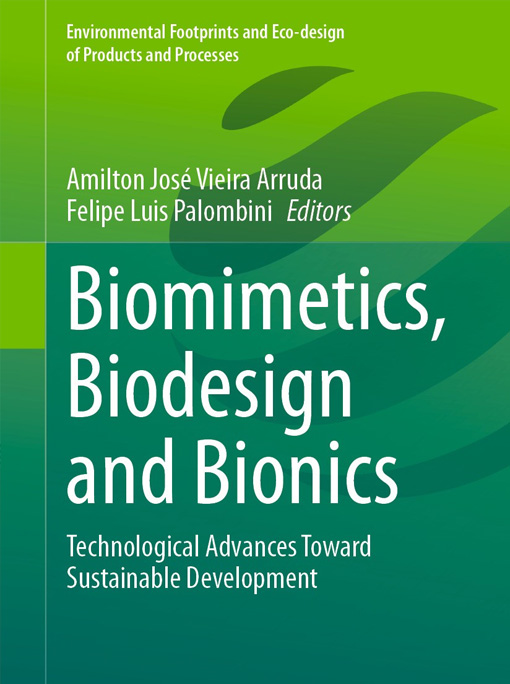
Dr. Amilton Arruda,
Dr. Felipe Palombini, eds.
Springer Nature
May 13, 2024
Hardcover
284 pages
Table of Contents
Didactic/Methodological Proposal: Use of the Natural Classification
as an Element of Bionic Studies. . . . . . . . . . . . . . . . . . . . . . . . . . . . . . . . . . . 1 Amilton José Vieira Arruda
Bionics and Design: 3D Microstructural Characterization of Cork
for the Development of Conceptual Products. . . . . . . . . . . . . . . . . . . . . . . . 21 Melissa Pedroso Schoffen, Mariana Kuhl Cidade,
and Felipe Luis Palombini
Bio-digital ‘Material Systems’: New Hybrid Ways for Material-Driven
Design Innovation . . . . . . . . . . . . . . . . . . . . . . . . . . . . . . . . . . . . . . . . . . . . . . 37 Sabrina Lucibello and Carmen Rotondi
Echinodesign: A New Model for Facilitating the Dissemination
and Effectiveness of the Biomimetic Design Culture. . . . . . . . . . . . . . . . . . 69 Valentina Perricone, Carla Langella, Gabriele Pontillo, and
Roberta Angari
Biodigital Product Design: Experiences in the Field of Applied
Research. . . . . . . . . . . . . . . . . . . . . . . . . . . . . . . . . . . . . . . . . . . . . . . . . . . . . . 109 David A. Torreblanca-Díaz
Method and Processes for Abstraction of Natural Microstructures
for New Product Development. . . . . . . . . . . . . . . . . . . . . . . . . . . . . . . . . . . . 149 Antônio Roberto Miranda de Oliveira and Amilton José Vieira Arruda
Biomimetics and 4D Printing: A Synergy for the Development
of Innovative Materials. . . . . . . . . . . . . . . . . . . . . . . . . . . . . . . . . . . . . . . . . . 173 Santina Di Salvo
Innovative Trends in Academic Pavilions: Exploring Processes
in Architecture. . . . . . . . . . . . . . . . . . . . . . . . . . . . . . . . . . . . . . . . . . . . . . . . . 201 Elton Cristovão da Silva Lima, Luís Miguel Cotrim Mateus,
and Amilton José Vieira Arruda
Levels of Access to Biomimetics. . . . . . . . . . . . . . . . . . . . . . . . . . . . . . . . . . . 227 Carla Langella
Biodesign as a Tool to Achieve Sustainable Construction Through
Additive Manufacturing. . . . . . . . . . . . . . . . . . . . . . . . . . . . . . . . . . . . . . . . . 251 Maria De Los Angeles Ortega Del Rosario, Carmen Castaño,
and Miguel Chen Austin
Index. . . . . . . . . . . . . . . . . . . . . . . . . . . . . . . . . . . . . . . . . . . . . . . . . . . . . . . . . 283
Biomimetics, biodesign and bionics are three branches of interdisciplinary research merging biological and applied sciences.
Nature is a vast source of inspiration and information for the resolution of complex problems and can influence many varieties of design. Biomimetics, biodesign and bionics are three branches of interdisciplinary research merging biological and applied sciences. This volume collects cases that highlight recent breakthroughs in these disciplines. Biological features such as patterns, shapes, mechanisms, colors, structures, and more can be analyzed, organized, and modeled for application in human creations. Therefore, design, engineering, and architecture projects can benefit from solutions that were already tested and verified through evolution in the natural world. With the development of new technologies for the investigation, simulation, and testing of natural features, the path from nature to product can be accelerated. The cases presented in this work showcase how technological advancements are leading to improved design solutions and influencing our very comprehension of natureand its complex organization.