
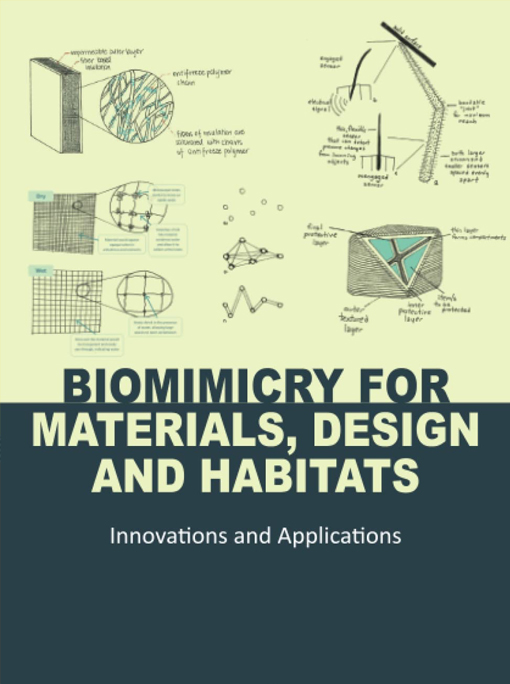
Biomimicry for Materials, Design and Habitats: Innovations and Applications

Marjan Eggermont,
Vikram Shyam,
Aloysius Hepp, eds.

Elsevier
February 21, 2022
Hardcover
590 pages

Table of Contents
Title page
Table of Contents
Copyright
List of contributors
Preface
Part I: Biomimicry education: Tools and perspectives
Chapter 1. Biom*: On becoming a teachable discipline
Abstract
1.1 Introduction
1.2 What is a discipline?
1.3 Teaching the skills of biomimetics
1.4 Conclusion
References
Chapter 2. Introduction to bio-inspired materials: Design, processing and applications
Abstract
2.1 Introduction
2.2 Natural materials: Novel structures, enhanced properties, and applications
2.3 Applications of bio-inspired polymers and related soft materials
2.4 Applications of biomimetics in materials science
2.5 Application of biomimicking in architecture
2.6 Advances in bio-inspired medical materials
2.7 Mimicking marine life
2.8 Summary and conclusions
References
Chapter 3. The pattern alphabet: Nature’s patterns are the language of spatial reasoning and biomimicry
Abstract
3.1 Introduction
3.2 The pattern alphabet
3.3 Spatial skills
3.4 Biomimicry
3.5 Points of engagement
3.6 Recommendations
3.7 Conclusion
Acknowledgement
References
Chapter 4. Material culture, design studies, and human ecology: A biocentered perspective
Abstract
4.1 Introduction
4.2 Context of design innovation
4.3 Naturally material and cultural
4.4 The nature of design innovation
4.5 Inter-connected habitats natura
4.6 Innovating biocentered praxis
4.7 Conclusion
References
Chapter 5. Inspiration from paleomimetics: Fossil does not equal failure
Abstract
5.1 A chronology of world views on fossils, evolution and extinction
5.2 Biomimicry and extinction
5.3 Understanding the process and predictors of extinction
5.4 Yesterday informs today
5.5 Practical challenges and opportunities in paleomimesis
5.6 Conclusions
Acknowledgments
References
Part II: Bio-inspired systems engineering and computer applications
Chapter 6. Biomimicry for natural and synthetic composites and use of machine learning in hierarchical design
Abstract
List of abbreviations
6.1 Introduction
6.2 Natural materials and synthetic composites
6.3 Artificial intelligence in hierarchical design
6.4 Final remarks
Acknowlegments
References
Chapter 7. Tools, behavior, and materials: What should we learn from animal nest construction?
Abstract
7.1 Introduction
7.2 Birds
7.3 Termites
7.4 Humans in context
7.5 Potential for biomimetic application
7.6 Conclusions
References
Chapter 8. Sample digitization techniques for bio-inspired engineering
Abstract
8.1 Bioinspiration
8.2 Digitization
8.3 Case studies for research use
8.4 Future of digitization
Acknowledgments
References
Chapter 9. Assessment of an ant-inspired algorithm for path planning
Abstract
9.1 Introduction
9.2 Preliminaries
9.3 Enhanced gain-based ant colony optimization
9.4 Results and discussion
9.5 Conclusion
Acknowledgment
References
Part III: Bio-inspired innovation: Materials, manufacturing and applications
Chapter 10. Functional synergy of biomimicry and additive manufacturing: Toward a bio-enhanced engineering approach
Abstract
10.1 Introduction
10.2 Additive manufacturing technologies
10.3 The roles of additive manufacturing in biomimetic research
10.4 Workflow for additive manufacturing in biomimicry
10.5 Future outlook and potential
Acknowledgements
References
Chapter 11. Smart textiles through bio-inspired innovation
Abstract
11.1 Introduction
11.2 Biomimetic functional textile surfaces
11.3 Biomimetic textiles for thermal comfort
11.4 Biomimetic electronic textiles
11.5 Biomimetic actuation and morphing in textiles
11.6 Conclusion
References
Chapter 12. Polymerization in nature yields clues to innovation in additive manufacturing
Abstract
12.1 Introduction
12.2 Additive manufacturing
12.3 Phase one: Autodesk and the Ember stereolithography printer
12.4 The 2015 Greener Solutions graduate course
12.5 The 2019 Greener Solutions course: Safer materials proposed for this new SLA approach
12.6 Summary
References
Chapter 13. Syntheses, mechanisms, and applications of bio-inspired self-cleaning surfaces
Abstract
13.1 Introduction
13.2 Self-cleaning in wet conditions
13.3 Self-cleaning under dry conditions
13.4 Multi-functional self-cleaning surfaces
13.5 Summary
Acknowledgements
References
Chapter 14. Commercialization journeys: Bringing biomimetic innovation to the market
Abstract
14.1 Introduction: The value of ecosystem services
14.2 What is biomimicry?
14.3 Formulating an idea
14.4 Biomimicry design process
14.5 Innovative startups and small and medium enterprise
14.6 Evolution of entrepreneurship and sustainability
14.7 The innovation economy
14.8 The trifecta of desirability, feasibility, and viability (IDEO U)
14.9 Biomimicry as innovation
14.10 Biomimicry commercialization process
14.11 Key steps of the biomimetic innovation process
14.12 Conclusion
References
Appendix 14A Technical feasibility and viability
Appendix 14B Business feasibility and viability
Appendix 14C Important factors impacting biomimicry technology
Part IV: Biomimetic habitation: Architecture and sustainable environments
Chapter 15. Morphological differentiation for the environmental adaptation of biomimetic buildings: Skins, surfaces, and structures
Abstract
15.1 Introduction
15.2 Adaptive building solutions
15.3 Environmental adaptation in nature
15.4 Biomimetics: Functional convergences and multi-functionality
15.5 Morphological differentiation
15.6 Morphological applications for environmental adaptation: Skins–surfaces–structures
15.7 Conclusions
References
Chapter 16. A case study in biomimetic roofing: Moisture dissipation from leaf-shaped shingles
Abstract
16.1 Introduction
16.2 Study approach and methods
16.3 Study results
16.4 Discussion of study results
16.5 Conclusions
Acknowledgements
References
Chapter 17. Design studies and applications of mycelium biocomposites in architecture
Abstract
17.1 Introduction
17.2 Mycelium as a biodesign collaborator
17.3 Potential use of mycelium in architectural design and construction: Overview of in-house efforts
17.4 Work of Biodesign Team Turkey on mycelium composites
17.5 Work of Stuttgart University on mycelium composites
17.6 Conclusion
Acknowledgments
References
Chapter 18. Green Harbors Project: Biomimicry in action
Abstract
18.1 Green Harbors Project overview
18.2 Why restore native oysters and their reefs?
18.3 Green Harbor Project in Wellfleet Harbor, MA, USA
18.4 Green Harbor Project results and discussion
18.5 Conclusion
Acknowledgments
References
Index

This is a survey of works by recognized experts who employ biomimicry and related paradigms to solve key problems of interest within design, science, technology, and society.

Biomimicry for Materials, Design and Habitats: Innovations and Applications and is a survey of the recent work of recognized experts in a variety of fields who employ biomimicry and related paradigms to solve key problems of interest within design, science, technology, and society. Topics covered include innovations from biomimicry in materials, product design, architecture, and biological sciences. The book is a useful resource for educators, designers, researchers, engineers, and materials scientists, taking them from the theory behind biomimicry to real world applications.

Living systems have evolved innovative solutions to challenges that humans face on a daily basis. Nonlinear multifunctional systems that have a symbiotic relationship with their environment are the domain of nature. Morphological solutions for buildings inspired by nature can be used for skins, surfaces, and structures to facilitate environmental adaptation of buildings to increase occupant comfort and reduce energy demands. Birds can teach us to produce novel structures, 3D printing can be informed by oysters and mussels, and mycelium may show us the way to fabricate new biocomposites in architecture. Therefore, it is in nature that we seek inspiration for the solutions to tomorrow’s challenges.

  • Presents new directions in education and the various applications of biomimicry within industry, including bio-inspired entrepreneurship
  • Discusses the role of biomimicry in education, innovation, and product design
  • Covers applications in systems engineering and design, novel materials with applications in 3D printing, and bio-inspired architecture
  • Includes perspectives on sustainability detailing the role that bio-inspiration or biomimicry plays in sustainability

Amazon available >